The Alzheimer's Association Blog Has Moved!
In an effort to provide higher quality content and serve our readers better, we're moving our blog to a newer system. Please take the time to see our new and improved blog at: http:///blog.alz.orgThanks much, and keep reading!
World Alzheimer's Day 2010
Today, World Alzheimer’s Day 2010, we have seen new levels of attention around the reality of Alzheimer’s disease, including the millions affected in the United States and across the globe. More than 40 research riders in the Alzheimer’s Breakthrough RideSM arrived in Washington, D.C. to deliver the signatures of over 100,000 Americans who want Congress to make Alzheimer’s a national priority. Alzheimer’s Disease International released the new World Alzheimer Report 2010, highlighting the growing costs of dementia care. All week long, Alzheimer’s Association Celebrity Champions are appearing on “Who Wants to be a Millionaire” to raise awareness and funds for Alzheimer research, care and support. Throughout the next few months, thousands of people across the country will duplicate their efforts by participating in local Memory Walk® events. Despite these small victories, Alzheimer’s disease looms in a state of deepening crisis. More than five million Americans are affected by this devastating disease, a number that will only grow faster as the baby boomer generation ages. Left unchecked, the costs for Alzheimer care and services will continue to rise, straining our overwhelmed healthcare system and threatening to bankrupt Medicare and Medicaid. Bearing these things in mind, we must remain vigilant in bringing more support to our cause: It is the support at of people exactly like you who have helped to make World Alzheimer’s Day 2010 such a success. And it will be people exactly like you who drive the change necessary to bring an end to Alzheimer’s disease in the future. Thank you, Angela Geiger, Chief Strategy Officer, Alzheimer’s Association
Alzheimer's Breakthrough Ride Journal: Indianapolis to Ann Arbor
 In light of what those who rode before us have endured, I wish I had a tale of woe to tell, but alas, this particular segment of the Alzheimer’s Breakthrough Ride was nothing shy of epic riding. We had trained for all conditions…except perfection. By the mid-afternoons, it was mostly sunny and in the low 80s. The few clouds that were present had that distinct late summer softness to their contours. If it can be imagined, it was as though Ann Huston took her paintbrush to the Midwestern sky. As a cyclist though, your eyes should be on the road, and the roads we traveled were oddly smooth - a particularly lucky happenstance given that back roads in the Midwest are often abused by winter and neglected by man. Then there was the greatest gift of all - an unceasing tail wind that nudged us along 215 out of the 289 miles. The three of us shattered our previous records, reaching speeds in excess of 35 mph on the flats. We didn’t maintain this speed; we just wanted to see what was possible, so on a perfectly smooth country road about 30 miles out of Indianapolis, we let loose for just short of a ½ mile. As if the weather and roads weren’t gift enough, we were also graced with the company of Evan, Melanie, and Glenn – the greatest Pony Express crew ever assembled. As much pain as I may experience after 290 miles of riding, I was sad to leave them and would happily have pedaled on through the next segment just to share their company for a few more days. They have been on the road for eight weeks with at best a day or two off, and yet they managed to keep us warm, keep us fed, keep us hydrated, and to keep us laughing for four days. Perhaps needless to say, they also managed to find their way into our hearts. It isn’t of great surprise that the people associated with this ride - such as Melanie, Evan, and Glenn - would be people of exceptional spirit. It isn’t of great surprise that those of you reading this would be people of exceptional compassion. For most of us, we are all too familiar with the pain that this disease brings. But bore of this pain, is an incredible beauty and testament to the human spirit: We now stand together in hope, in faith, and in action that we will bring an end to the heartbreak that is Alzheimer’s disease. I am honored to stand amongst you in this effort and I wish us all an epic success. - Angela Bruno is a neuroscience doctoral candidate at Rosalind Franklin University of Medicine and Science (RFUMS).
Alzheimer's Breakthrough Ride Journal: Cleveland to Pittsburgh Day 2
First of all, I am not an Alzheimer’s Researcher. I am what was often referred to as an “other,” meaning I have a personal connection to Alzheimer’s disease. My wife is a genetics researcher and a colleague of Dr. Bruce Lamb. Bruce sent a fundraising email to my wife, she forwarded it to me thinking I would “sign the petition and donate $50.” Instead I emailed Bruce, explained my story and asked to join the team Cleveland Rocks. Boy was she surprised that evening! On day 2, our team consisted of me, Dr. Bruce Lamb and Dr. William Lynch. Both Bruce and Bill were more experienced riders than I; I actually bought my road bike the last week of July. Not that I wasn’t active before joining the team, but I was training for a sprint triathlon, not a long distance ride. Needless to say, I began hill and endurance training immediately. I am riding in honor of my Grandpa Darrah, who died with Alzheimer’s disease. I found that my training rides and my ride from Cleveland to Pittsburgh were spent thinking of my grandpa and grandparents in general. All of my grandparents have passed but I feel very lucky to have known them well. My grandpa Darrah was more than just a grandpa; he was also a friend and roommate. I lived with him for almost seven years, and ended up being one of his primary caregivers. Our day 2 from Boardman, Ohio to Pittsburgh, Pennsylvania was rather uneventful, except for the constant rolling hills. In some ways I am glad that Bruce and Bill were often a little ahead of me, because I was often talking or chanting to myself. I found myself saying “this is not suffering.” I remembered my grandpa’s anger and frustration as he would try to communicate his needs and wants but couldn’t. I often whispered on the toughest hills “this is only one hill” thinking grandpa and others with Alzheimer’s had years of “tough hills.” I remembered coming home one day to find my grandma’s silver flatware in the garbage, when I removed it he said “but I have a lot of that” referring to the normal silverware. It was these memories and occasional chanting that got me through the constant hills. All of these memories and the hills made the ride a bit of an emotional rollercoaster, in addition to a physical one. Bruce and Bill were wonderful to ride with; they were supportive and helped to keep things light. The road crew of Melanie and Glen were awesome; they seemed to anticipate our every need and I always felt safe even with semis and dump trucks barreling down on me. I am a little disappointed that I never got to try the famous Peanut Butter Fold Overs…oh well, maybe in D.C. I think my favorite part was the people we met along the way either at the hotel, a rest stop or at the signing event. Their appreciation, stories and personal dedication truly made this a special experience that I will never forget. - Michael Darrah
Alzheimer's Breakthrough Ride Journal: Ann Arbor to Cleveland Day 2
 The second day of the ride from Ann Arbor to Cleveland started similar to the first. It was a crisp, cool (52 degrees) morning as we headed out of Perrysburg towards Sandusky at 7 AM (a total of a little more than 60 miles). Although a bit warmer than the first morning, Charlie and I still had on our tights, gloves and windbreakers for the first few hours of the morning. There was also a forecast of rain for later in the day. I was feeling a bit stiff from the first days ride, but slowly loosened up over the first few miles. We had several railroad crossings that both Charlie and I had a much greater respect and appreciation for after the previous days ride. A bit after the first rest stop, we had our first excitement of the day. As we passed a small farmhouse, a medium to large size dog, bee-lined towards my bike with teeth bared and a ferocious snarl. I instinctively sped up and swerved onto the opposite side of the road (thankfully few cars were on these roads this early on a Saturday morning). With the dog at my heels and my heart pounding, I thought about trying to kick the dog, although my shoes were firmly clipped into my pedals. Instead, I sped up even further and after an equal burst of speed from the dog, he finally retreated to the side of the road. I turned around to see if the dog had any designs on Charlie, who was only 50-100 yards behind me. Thankfully, the effort required in chasing my bike seemed to have exhausted the dog who remained on the side of the road panting. For the rest of the day I relived this episode and jumped off my bike at the sound of every barking dog… The next 20 miles or so were into a strong head wind that both Charlie and I felt like we were slogging through even though the terrain was quite flat. After an excellent lunch on the Pony, we completed the day uneventfully and arrived into Sandusky just as the first rain drops started to fall. That night we enjoyed hamburgers at a local restaurant/bar, which was filled with Ohio State buckeye fans rooting on their team. Later that evening, we were joined by my son (Raza Lamb) and Dr. Sanjay Pimplikar, who would ride the final day from Sandusky to Cleveland with us. The three days riding with Charlie were wonderful. We had cool days and dry, flat roads through wonderful farm country (albeit with a few too many railroad crossings and dogs!). In addition, it was inspirational to ride with a 75-year-old man who was so committed to bringing awareness to dementia and Alzheimer’s disease. We talked at length about how as Americans we need to do much more to effectively integrate individuals with Alzheimer’s disease and their caregivers into our families, communities and society.
Alzheimer's Breakthrough Ride Journal: Ann Arbor to Cleveland
I started my adventure at the signing event in Ann Arbor on Thursday afternoon where I was deeply moved by the story told by a young lady about her life with a 31 year old husband who had early onset Alzheimer's disease. We started our trip early the next morning on a sunny day. Thankfully it was cool, which prompted me to wear several layers of clothing. This served me well shortly after breakfast when I had a small altercation with a rail road crossing. The result was only some mild "roads rash" and injured pride. The remainder of the day went well and I was able to enjoy the rest of the trip. I road the 200 miles to Cleveland to find my wife Carolyn who is slipping into the fog of dementia. Her talents as a mother, wife, scientist, and doll artist are being shrouded by a thick haze, but SHE IS STILL THERE. It is up to me as her primary care giver with the help of our family, friends, and our entire community to shine some light through the haze and highlight her unique talents and thus to preserve her intrinsic value and worth, which is her humanity. It is incumbent on all of us to seek out those who are being drawn into the murky world of dementia and to continue to highlight their uniqueness and preserve their humanity. -Charlie Farrell, M.D., is a retired vascular surgeon with a life-long interest in participating in and promoting running and multi-sport training.
100,000 Americans Demand an Alzheimer's Breakthrough
Thank you and congratulations! With your help, the Alzheimer's Breakthrough Ride SM has collected 100,000 signatures for a petition asking Congress to make Alzheimer's disease a national priority. We deeply appreciate your efforts to make this goal a reality. On Sept. 21, World Alzheimer's Day, the Ride will culminate in our nation's capital as researchers who collectively cycled more than 4,500 miles cross-country deliver signatures to Congress. These riders are sending a critical message on our behalf: Alzheimer's disease can no longer be ignored. We must have additional resources for research, care and support. But this isn't the finish line in the fight against Alzheimer's. Take further action today: Thank you for helping to make Alzheimer's disease a national priority. We're proud to share your voice with Congress on World Alzheimer's Day. With gratitude, Bruce Lamb, Ph.D.Associate Staff ScientistLerner Research InstituteCleveland Clinic
Alzheimer's Breakthrough Ride Journal: Madison to Chicago and Points Beyond
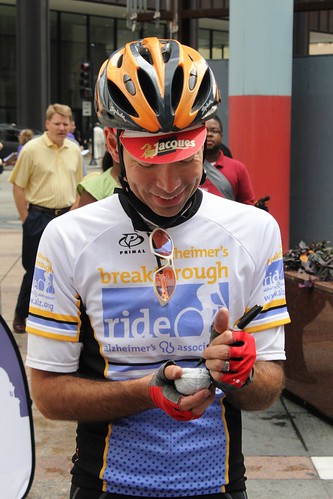 My journey on the Alzheimer’s Breakthrough Ride would consist of three days of riding. Two days to complete the Madison-Chicago segment and an additional day to ride the first leg of the Chicago to Indy segment. Each day brought something new: meeting great new friends, inspiration in the fight against Alzheimer’s, and great riding through America’s heartland. I finished up our lab work on Tuesday and headed to Madison, where the weather looked rather daunting for the following day’s ride. Bright and early, I met the other riders in the lobby of our hotel. Well not so bright due to the ominous clouds, but certainly early. The brightest parts of the morning were actually the team of riders - Barb Bendlin, Michele Riese, and Michael Walters as well as the incredible support staff, Evan, Glen and Melanie. We got to know each other over a hearty breakfast, and then it was time to ride! Miraculously, the heavy weather stayed ahead and behind us as we made our way through the rolling hills of southern Wisconsin toward the flat prairies of Illinois spurred on by cool temperatures and a slight tailwind. As others have noted, Glen and Melanie in the follow and lead cars did a great job of keeping the traffic at bay. The rain also kept mostly at bay, but we occasionally found ourselves pedaling through a chilly spritzing. Our spirits could not be dampened, however. After each stop, we began pedaling again with a rousing cry of “Breakthrough!” Barb and Michele had seemingly boundless energy while Michael, who had some reservations about the distance initially, began to realize his cycling potential with every passing mile. Things were going great until a set of slick train tracks in Edgerton, WI sent Barb and Michael to the pavement. When a police officer came by to offer help, Barb’s only request was that he sign the petition! Way to stay on message, Barb! After some patching and bandaging, we were on our way again. Breakthrough! The rain cleared out and we finally arrived at Woodstock, IL 90 miles, and 2000 kiloJoules later. We averaged a little over 100 watts of power output while riding - 4 bright light bulbs riding to abolish Alzheimer’s disease. Woodstock was a gracious host. Thursday was an eventful ride into Chicago. In the “+” column: We were joined by Alzheimer’s Association CEO Harry Johns, who would ride with us all the way into Chicago. In the “-” column was the rain and a flat tire just a few miles from our destination in downtown Chicago. We knew there was a crowd waiting to meet us, and the rain had already pushed us behind schedule, even forcing an unplanned shuttling of bikes and riders for part of the segment, so a quick tube change and we were on our way again. At about 1PM, we arrived at the Thompson Center to the cheers of the assembled crowd - an amazing and inspiring moment. The energy was high as some heartfelt speeches were made and more signatures were collected. Chicago’s my home town, so I couldn’t resist a quick trip into the lab to check on an experiment. Then it was back to the hotel to say goodbye to the Chicago-to-Madison team (see you in DC!) and to get some rest for Friday’s ride into Indiana. On Friday morning, Kevin Laxton and I set off in the chilly morning air with the sun rising over Lake Michigan as our backdrop. On the lakefront path, I saw some friends who wished us luck on our journey. We had about 90 miles to ride, but the open roads and beautiful prairie fields of Indiana made it go by in a flash. We happened to ride by Fair Oak farms in Indiana, so I convinced the crew to stop and try some cheese curds which squeaked with freshness. The woman at the checkout counter told us her grandmother suffered from Alzheimer’s disease and wished us luck on our ride. From there, it was a short ride to Rensselaer, IN where we’d stop for the night. Marc Prevot came in that evening to continue the ride with Kevin, and I headed back to Chicago full of inspiration and gratitude to have been part of this excellent endeavor. These three days were certainly some of the most meaningful miles I’ve ever pedaled my bike through. I’m looking forward to continuing the effort in DC. It’s time we made Alzheimer’s disease a national priority.
-Eric Norstrom, Ph.D., is a postdoctoral scholar in the department of neurobiology at the University of Chicago.
Alzheimer's Breakthrough Ride Journal: Madison to Chicago Part 2
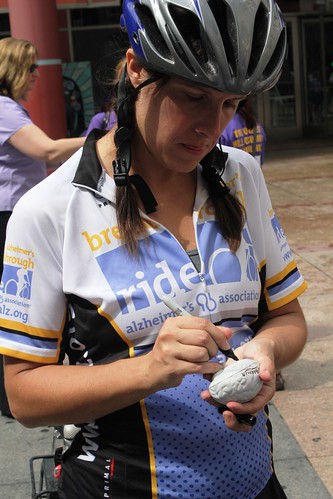 On Tuesday morning I met my fellow riders (Eric - who I believe is still on the road) and Michael. My friend and colleague Barb was there also, and Mel, Glenn, and Evan - the most fabulous, helpful road crew a bicyclist could ever hope for!! (Thanks you guys!) The organization of this event and the people I got to meet made this a fantastic experience. Day 1 was spent riding through country roads of Wisconsin - enjoying the beautiful hills, foliage that must have been 8 shades of green, rows of fully-grown corn and soybean plants, and the interplay of high gray clouds and misty low-lying clouds moving across the sky. At that point, we bikers owned the road and were able to chat and get to know each other. The afternoon in Illinois found us on busier thoroughfares, and we were funneled into a single-line formation - braving tractor trailers and tiny road shoulders with potholes. Rain was sporadic through the afternoon, but really was mostly refreshing as the day wore on. On Day 2 there was quite a bit of rain. But like the brave soldiers we were, we headed out en force! We made our way along some busy roads in Illinois. After some lessons in defensive driving on a bike, we moved through some pleasant neighborhoods, and then onto a lovely, lovely and oh-so-peaceful bikepath. I'll admit (I'm probably not supposed to say this), we did get washed out for a bit - the rain necessitated some travel-by-van. Riding through Chicago was probably my favorite part - and the reception downtown was just marvelous. The total experience on this Madison-to-Chicago leg was one that I would unhesitatingly want to do again! Not only did I get to assist in raising awareness for the Alzheimer's Breakthrough Act, meet fabulous people, and undoubtedly improve my BMI, but I learned a few tips about bicycling that I'm happy to pass onto readers of this blog. These may sound obvious, but even I (a self-proclaimed master-of-the-obvious) found that these tips would be good to have in mind once mounted on a bike. - Don't ride with a flat tire. (I have no idea of how long I did this... but when riding with a flat and trying to keep up with my teammates, the thought occurred to me that I must be riding with Olympians.)
- Ride perpendicular to railroad tracks. The emphasis on this should be multiplied by 3 if it has rained. Emphasis should be multiplied by 10 if it has rained AND there is corn on the road. (2 of my teammates learned this the hard way - and they have the battle wounds to prove it. Both looked pretty dazed and confused immediately after the fall. I haven't told them personally yet, but they're my heros.)
- Be a courteous cyclist. By this, I mean - point out to your fellow cyclists upcoming potholes, cyclists, cars, etc. that one would want to avoid coming in contact with while on a bike. (FYI: Eric Nostrom is the most courteous cyclist I have ever met - not that I've actually met that many cyclists - but I do think it would be hard to beat him in this category.)
- Eat something! Almost everyone on the trip said this to me in an assertive - but certainly-not-chastising tone at some point over the course of 2 days. And you know what? They were right! So for God's sake - Eat something!
- Wear a helmet. (For an example of why this is important, see point 2)
- Cycle for a good cause!!! I'll say no more. Everyone on this site knows this is important.
I'm glad to have been a part of this event! Alzheimer's research is certainly in need of more funding. Although I won't be in D.C., my heart will be there. Thank you Bruce Lamb for generating the idea for this ride, and best of luck to the leadership of the Alzheimer's Association while in D.C. and beyond!! And I send my love to those folks out there who are personally touched by Alzheimer's disease. This ride is a sign of our (i.e., researchers, clinicians, and everyone involved in this endeavor) commitment to you.
- Michele Ries, Ph.D., is an assistant scientist in the School of Medicine and Public Health at the University of Wisconsin in Madison.
Alzheimer's Breakthrough Ride Journal: Madison to Chicago Part 1
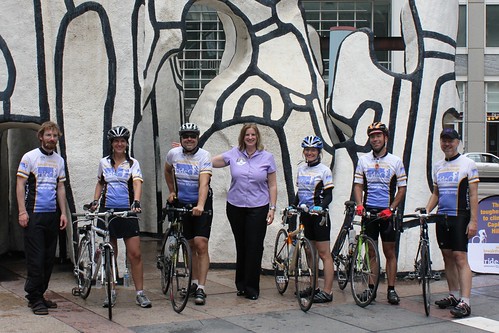 I recently rode in the Alzheimer’s Breakthrough Ride, a cross-country relay to raise awareness about Alzheimer’s disease. I rode in the leg from Madison to Chicago on September 1-2. What follows are the notes I recently posted on the blog associated with the ride. Alzheimer’s Breakthrough Ride Journal: Madison to Chicago My Breakthrough Ride experience began in mid-April when the winter snows unexpectedly receded from the Minneapolis landscape and I could start training on the bike trails around Lakes Harriet and Calhoun. I was quite anxious about the ride, given that I hadn’t ridden over about 20 miles at one time in many years. And I knew that we would be riding 90 miles on the first day out of Madison and about 65 miles on the second day to get to Chicago. I rode the trails in high winds, in sleet, in winds that pushed my bike from the path as angry spring storms blew in off the Canadian plains. Why did I do this? Apart from the obvious challenge the ride itself presented, I was inspired in my training by Dr. Karen Ashe, an Alzheimer’s researcher at the University of Minnesota, and Director of the N. Bud Grossman Center for Memory Research and Care. Her passion for discovering a means to prevent Alzheimer’s disease instilled in me a desire to do something that could help make an impact on the course of Alzheimer’s research in the United States, and could help change the course of how we prevent and treat the disease in a global sense. I view my participation in the Breakthrough Ride as one tiny part of a collective effort to make the dream of a world without this scourge of a disease a reality. So I pedaled through April, May, June, July and August. In the heat and wind, past roller-bladers, low-riders, and Burley’s. In these pages, I read with trepidation of the heat, the winds, the spills as the relay moved across the desert and on into the Midwest. But more than being impressed by the challenge of the elements alone, the depth of emotion and passion of the researcher-riders fascinated and inspired me to continue on to my appointment in Madison. As it turned out, the ride was certainly not as hellacious as the premonitions my tired mind had conjured up. The weather on the first day (Madison, WI to Woodstock, IL) was overcast and cool, relative to the 100+-degree days that previous legs of the relay had to endure. The rolling hills and cornfields of southern Wisconsin were beautiful. Sure, a 90-mile ride is never easy, but the care given to us riders by the relay-support staff (Glenn, Melanie, and Evan) transformed miles into rides-around-the-block and hours into minutes. There were the trucks and harried auto drivers to deal with and the rough shoulders and the cracked pavement, too, but the smiles and the jokes and the sharing and the PBFO’s (peanut-butter fold-overs) took away the “mental” part of the ride. And the training I had done over the proceeding weeks turned out to be sufficient enough to smooth out the physical challenges of the long ride. The second day turned out to be a bit more of a challenge. Our second-day leg was interrupted by heavy rains that always seemed to be on the verge of letting up, but never really doing so. Since we had to be Chicago for the noontime rally, we were “airlifted” to an advance drop-site on the Lake Michigan shoreline. The rain stopped and we were led into Chicago by Harry Johns, the CEO and President of the Alzheimer's Association. (Of course, we had a flat tire in the last four miles of the ride!) Actually, Harry insisted that Barb, Michele, Eric and I lead the group of us into the Chicago rally. But there is no question that Harry led us into Chicago since there is no way anyone else could have described and followed the route he led us on through the maze of paths, into a parking garage, and down a grass covered embankment to the streets of the Windy City. We finally entered the chaos of Chicago noontime traffic when we made it to Randolph Street and could sense that the completion of our ride was only a few blocks ahead. I remember turning to Eric Norstrom (a native of Chicago) and asking him if there were any rules for driving in Chicago traffic. I think I heard him say “try to miss the cars!” It was an exciting last few blocks to the Thompson Center where we were cheered into the Plaza by an enthusiastic, cheering crowd of well-wishers and volunteers. (Shades of “Ferris Bueller’s Day Off” but without the music or Mia Sara.) What a great way to end a trip I will never forget! Did I forget to mention the incident at the Edgerton Crossing? Suffice it to say that I now know that it is critically important to traverse railroad crossings at a vector perpendicular to the tracks and at slow speed. Despite admonitions to this effect that I had received seemingly only hours before, I attempted the impossible and lost to gravity and lack of friction. Luckily nothing was broken, though I suspect I might have bent a rail. (Stacy, my wife, and I visited the infamous site on our way home to the Twin Cities and some damage to the rails appeared evident.) The fall was scary and painful and embarrassing and bruising. It was a challenge for me to pick myself up and keep going, fearing another fall or another set of railroad tracks. But I knew that I would heal, the bruises would fade, and the scrapes and scratches would eventually stop bleeding, scar over, and disappear. And this made me think of those afflicted with Alzheimer’s disease and their care-givers and families and friends for which there is pain, and fear, and embarrassment and scrapes and scratches with no hope of recovery. And that is what helped get me back on my bike and continue the ride, filled with the hope that our riding and the signatures we are gathering, and the enhanced funding we seek might lead to a future where the healing of those with Alzheimer’s disease could start, and their fear and bruising and trauma and anxiety could be made to fade away. Good luck to the riders and I will see you in Washington! -Dr. Michael A. Walters is a member of the faculty of the Medicinal Chemistry Department at the University of Minnesota, a Director in the Institute for Therapeutics Discovery and Development, and a collaborating member of the N. Bud Grossman Center for Memory Research and Care.
Alzheimer's Breakthrough Ride Journal: Saint Louis to Madison
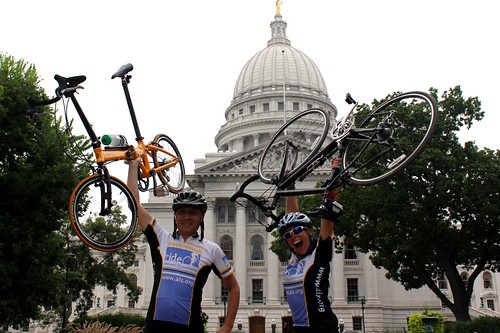 Before I begin to explain my journey from St. Louis, Missouri to Madison, Wisconsin, I would like to tell you a little about myself. I am a graduate student at Boston University School of Medicine in the Department of Anatomy and Neurobiology (finishing up this year – fingers crossed!), and I am conducting my thesis work in the laboratory of Dr. Rudy Tanzi in the Genetics and Aging Research Unit at Massachusetts General Hospital. On a personal note, my mother started showing symptoms of Alzheimer’s disease at the age of 56, when I was 21 years old. In November 2006, she was officially diagnosed with the disease at the age of 60, and at that point I became an Alzheimer’s caregiver in addition to Alzheimer’s researcher. Over the past few years I have witnessed my mother’s gradual mental decline, to a point where she is unable to recognize me anymore. Moreover, the effect my mother’s decline has had on my father, her primary caregiver, is utterly devastating. I return home to Rhode Island frequently to relieve my father of his caregiving duties, and these trips are generally filled with exhaustion, frustration, and sorrow. I rode a total of 350 miles with my parents in mind the entire time. Many people commented that I must be so brave to commit to so many miles. In my mind there is nothing more terrifying than Alzheimer’s disease, and I could only hope to be as brave as my mother and father, who have the courage to face it every single day. 8-29-10 After filling up on Mexican food and saying farewell to Team Boston Bikers who rode with me from St. Louis to Springfield, I met Dr. Rong Wong of Mount Sinai School of Medicine, who would be biking with me for the next 3 days all the way to Madison, WI. The following morning at breakfast my second meeting with Rong was quite interesting. I was complaining to the support crew (Evan, Kyle and Glen) about how the softness of hotel pillows generally leaves me feeling restless and sore. Rong’s response was “Oh what a baby, she needs her own pillow.” I could tell right off the bat it was going to be a fun 3 days, in all seriousness. I have to admit, I was nervous about having to ride 96 miles that day following a slightly tortuous 103 miles the day before. But when Glen checked my tires he immediately realized I was riding at 60psi the entire first day as opposed to the 120psi my tires could handle. Woops. And let me tell you – a little bit of air makes a huge difference! Due to the fact I was scheduled to ride 350 miles total through 3 states (MO, IL, and WI), many people asked me if I was an avid rider. My response? I bought my first road bike when I signed up for the ride in May. Relatively speaking I was close to knowing nothing about my bike, and for this (among other reasons) the Breakthrough Ride support crew was a Godsend. That first day Rong and I began our 96-mile trek from Springfield, IL towards Peru, IL. It was cool and nice until around 11:30 or so, when the hot sun and little hills kicked in. I was under the impression Illinois was flat! After a lunch break in front of a cute little church with a very friendly congregation (it was Sunday afterall), Rong and I convinced ourselves that the worst of our hills were behind us, only to be faced with a monster of a hill a half-mile down the road. I admit, it must have been harder for Rong with his crazy folding bike to climb that hill than it was for me with my road bike. Best advice for future riders: don’t bother studying the elevation map. It’s best to keep it a surprise. I met my other mortal enemy at the end of Day 1 for the last 3 miles or so: WIND! Needless to say, I couldn’t wait to be done for the day, and the feeling of accomplishment when I reached the end could not be topped. It felt good to temporarily trade in my pipette for a bike. I treated myself to some fried pickles and a chicken salad stuffed tomato at a local restaurant called Cabin Fever and headed to the hotel Jacuzzi to prepare my muscles for the next day. 8-30-10 Today Rong and I rode from Peru, IL to Freeport, IL (home of the Freeport Pretzels) – a total of 83 miles. After completing nearly 200 miles in the past 2 days this seemed like nothing! When I was training for the ride I imagined I would experience more and more muscle fatigue with each passing day. But strangely I could feel myself riding stronger with time. Luckily, Rong rode behind me the entire time and gave me tips on my form. I will also be forever indebted to Rong for all the beautiful photos he took on the road to capture our journey. He literally attached his camera to his helmet strap and snapped pictures along the way! Melanie joined us with her support van at this point to give Evan a break, and she found Rong’s camera setup to be hilarious. On this day I opted for a different riding jersey – one that all my wonderful friends/supporters signed before I left for the ride. Their words of inspiration carried me through the day. I also began to view the RV (or the “Pony”) as some sort of drug. It was such a wonderful feeling to see the Pony after a rough 20-mile stretch, and I began to depend on that feeling to break up the monotony of the ride. I mean, corn and soybeans are great and all, but exactly how many fields are there? We did meet a body of water for the first time on our journey this day, and this excited Rong to no end, so we stopped and took plenty of pictures (although we never figured out what body of water it was exactly). Our average speed increased by at least 3mph on this day and we were in Freeport by 2:15. This is when things began to get interesting. We checked into the Freeport Super 8 Motel (which, by the way, was supposed to be a Holiday Inn Express) and I was assigned to room 115. We all agreed to meet in the lobby for dinner at 5:00. Lucky for me, Footloose was on TV in the meantime. I was slightly annoyed by the footsteps stomping back and forth in the room above me, but I managed to drown them out with the TV. I was ready and in the lobby by 5:05, and because I’m chronically 5-10 minutes late, I didn’t regard this as a big deal. There was no one, however, in the lobby so after waiting for 5 minutes I figured we were meeting later and I simply got the time wrong. When I walked back out at 5:30 both Kyle and Rong were waiting patiently. Apparently they were waiting there since 5:00, so they say. Weird. After a lovely Italian dinner at Mama Cimino’s Pizza, we returned back to the hotel. The footsteps continued to be bothersome and I was beginning to think something strange was going on. I fell asleep feeling a tad apprehensive about my environment yet excited for the final day of my journey. I began to dream about something coming through my window at me, and I woke up gasping, in a cold sweat, trembling from head to toe, and standing up alongside my bed. And then I saw it – the bedside lamp (on the opposite side of the bed) had been smashed in the middle of the bed! I am not generally a superstitious person, but I firmly believe a ghost wanted me out of room 115. I promptly packed up my things and complied by switching rooms. As I was leaving I could still hear the footsteps moving back and forth above me. 8-31-10 We met downstairs for breakfast the next day and I animatedly told everyone about the last night’s adventure. Amidst my excitement I was hit by bad news. Melanie informed us we had to get to the signing event by 12:30 that day – covering nearly 70 miles plus breaks. It seemed like a tough feat to take on, yet quite doable considering the average speed Rong and I had gotten up to on our bikes. Shortly after departing the haunted Super 8 Motel, we crossed the border to Wisconsin and were instantly met with the real hills. They were beautiful large rolling hills that made the hills previously encountered look like small bumps in the road. The humidity was ridiculously intense too! Rong actually shorted out his camera that was attached to his helmet (don’t tell his wife). SO unfortunate because the scenery in the southwest corner of Wisconsin is absolutely breathtaking. As we rolled along, I began to think we wouldn’t make it in time. After the first rest stop where Melanie filled my tires and I posed for a picture next to a sign advertising “Wisconsin Fresh Cheese,” I began to see an end in sight. I thought about my whole journey and how much the Alzheimer’s Breakthrough Act means to my family and tears began to well up in my eyes as I rode up and down the hills (not exactly safe, I know). A sense of adenine began to take over like none I’ve felt before and I actually felt lifted up the hills with strength that was not exactly mine. Rong managed to keep up with his folding bike and only complained a little. We were making great time! We reached the last rest stop 12 miles away from the Capital Building in Madison, where the signing event was to be held. We stopped at a nursery that was apparently the home-sweet-home to thousands of evil mosquitoes. Adequate rest was not possible while being eaten alive, and as Rong commented, “She is obviously not a country girl,” we were on our way towards the capital. We were a few miles away and I was thoroughly exhausted. And then I saw it. Quite possibly the most beautiful sight ever: The Golden Arches. I decided then and there that if Melanie pulled into the McDonald’s, I would be forever indebted to her. Well she not only pulled into the lot and parked the van, she also bought me a large fry and a caramel frappé. Now I am not the biggest fan of fast food chains, but the caramel frappé has changed my life, and the one I drank that day 3 miles away from the finish line was like no other. After convincing Rong to try a french fry dipped in sweet-n-sour sauce (he was a fan!), we were back on the road. We biked the final 3 miles on the bike lanes of Madison, WI and reached the Capital Building in no time. We rode up the sidewalk amidst the cheering onlookers and TV cameras and I prayed I wouldn’t fall off my bike. There we met riders Michele Ries and Barbara Bendlin who would be heading towards Chicago the following day. After posing for photos and listening to some rousing speeches concerning the great need for Alzheimer’s research funding, there was suddenly an interruption in the program. A woman from the crowd began to adamantly thank the riders with much enthusiasm. With everyone’s attention on her, she went to the microphone and explained with tears in her eyes that she was just diagnosed with a form of dementia, and her husband counted down the days for her so she could come to the signing event and thank us in person. Trying to control my own tears, I hugged her. It was the ultimate reminder of why we researchers are participating in the Alzheimer’s Breakthrough Ride. Please Congress consider the Alzheimer’s Breakthrough Act as an upmost priority, it is absolutely critical to the future of our society. I would like to send a huge thanks to my wonderful parents, Nancy and Anthony Soscia, who have provided so much love and support over the years, and were the principal motivation for this endeavor. I will never stop fighting for you. Big thanks to my amazing friends and family whose support I appreciated with every single pedal stroke. Much thanks also Cindy Lemere, Sarah Matousek, Oliver Holmes, and Rong Wong for being such fun riding buddies! And especial thanks to my lovely boyfriend Mark, who gave me a pair of custom-made Oakley sunglasses for the ride, with “Breakthrough AD” etched on the lens.
-Stephanie Soscia, Ph.D. Candidate
Department of Anatomy and Neurobiology
Boston University School of Medicine
Alzheimer's Breakthrough Ride Journal: Saint Louis to Springfield
 Just wanted to add to Buck’s blog….. What a wonderful, fantastic, invigorating experience! Thanks, Bruce Lamb for organizing this important event. Sarah Matousek, Oliver Holmes, Stephanie Soscia and I (Team: Boston Bikers) flew to St. Louis on Friday, August 27th in time to meet the Wash U team as they ended their ride at the signing event there. It was great to see familiar faces (Dave and Tracy Holtzman, John Morris, John Cirrito, etc.) and meet The Ride crew (Eric, Evan, Kyle, and Glenn) and numerous volunteers. After re-assembling our bikes (thank you, Eric!), we went sightseeing at the famous arch, also known as the “Gateway to the West”. It was a lot of fun getting to the top by elevator and seeing the city and Mississippi River. The next morning, we had the pleasure of meeting Buck Stinson, of Genworth Financial who, in part, deals with longterm healthcare insurance issues and is an avid cyclist. He kindly treated us to breakfast at the hotel. [Thanks Buck and thanks to the Courtyard Marriott staff for opening for us at 6 am instead of 7 am!] We headed onto the road north to Springfield just after sunrise. For most of us, this 100+ mile ride (also known as a “century ride”) was the longest bike ride we had ever attempted. We were so excited to get started! We were told it was going to be a flat ride, but the map we were given showed a steady, if small, incline over the first 80 miles. After a small gulp, I decided what the heck. Might as well go as far as possible. After all, we did not have to ride through the desert or across mountains like some of the riders before us! Along the way, we stopped for photo ops such as the one shown here in front of the sign for historic Route 66. The 2 support vans (drivers Kyle and Glenn) kept us safe as we navigated along the route and provided much-needed humor, music and encouragement along the way. The RV (driven by Evan) met us at rest stops where we were pampered with ice water, Gatorade, snacks, bananas, cold wet towels, and a bathroom. Perfect. After lunch, Buck rode ahead while Boston Bikers took our time, resting every 15-20 miles. As we rode through many small towns and rural areas, we got a few cheers and thumbs up. One gas station even posted a special sign welcoming us – Thank You! Our team stuck together but I will admit I was not sure I could make the whole 103 miles. Kyle was very good at showing up in the van when I would fall behind and blast some funky music to keep me going -- thank you. Thanks to you, too, Oliver, for getting me through that last patch before the final segment! It was everything. The last 20 miles of the ride was very flat with tall cornfields on either side of the road. The late afternoon sunlight cast a beautiful golden glow on the fields. We rode together into the final meeting place where Evan greeted us by hopping up and down and cheering for us. It was great! I want to thank my team members: Sarah Matousek and Oliver Holmes (postdocs, BWH) and Stephanie Soscia (graduate student, MGH) for their hard work raising funds, training, and doing the ride. It was truly a pleasure! Stephanie went on to ride for 3 more days and an additional 261 miles to Madison, WI. You are amazing! Great to meet you, Buck – hope to see you in DC. And lastly, a shout-out to all of the friends, family members, neighbors, and co-workers who supported us on this adventure and in the quest to find a way to conquer Alzheimer’s disease – THANK YOU!!
-Cynthia (“Cindy”) Lemere, Ph.D., is an Associate Professor of Neurology at Brigham & Women’s Hospital and Harvard Medical School.
Alzheimer's Breakthrough Ride Journal: Kansas City to Jefferson City
On the eve of the big Alzheimer’s Breakthrough bike ride, I was sequestered with my fellow riders, John Cirrito and Jess Resvito from Washington University, and Ben Timson, from Missouri State University, at the Comfort Inn in Sedalia. Since I hang out at the University of Missouri (in Columbia), we had most of the state covered. I think all of us were excited and a bit nervous, at least I was. Adding to my anxiety was watching Howard Palmer (Washington University) ride in from Kanas City, 110 miles away! While alive, he looked exhausted, and arriving before him was Tim West, also from St. Louis, who had been on the trail for four consecutive days (from Wichita, Kansas to Sedalia, Missouri), over 300 miles! I began to think that maybe I was over my head here. Passing time by checking my messages I found one from Linda Fisher who lives in Sedalia and who is the author of an edited book of personal stories of persons personally affected by the disease, including one from me. She wanted to come and take pictures, get some quotes, see us off in the morning. I replied, “Sure,” and just in case it was too early for her, I gave her the quotes listed below: “Linda, you ask why am I doing this? Many reasons:
- I believe in the cause -- research funding levels for Alzheimer's Disease is dismal given the tragic toll it is taking on individual lives, families, and others. And the cost of care is simply staggering. We are riding to encourage Congress to push funding to $2 Billion and make AD a major priority like other devastating diseases.
- We must and can find a treatment and cure; science has come a long way and we are on the cusp of major discoveries but need research funding and commitment of the U.S. government to follow-through with groundbreaking research.
- I am the current President of the Board of the Mid-Missouri Chapter of the Alzheimer's Association, and I want to make a statement to all those who support what we do that we are very serious about finding a cure for this disease and that we are dedicated to helping caregivers who truly live 36-hour days with those who suffer from this cunning, baffling disease.
- I am 68 years old, have a stent, poor knees, and lousy hearing, but I am functional and I know I can ride this bike 71-miles for this worthwhile cause. I'm looking forward to it.”
Absolutely, these are indeed the reasons why I volunteered to ride one of the segments in this coast-to-coast marathon. I should add that my great aunt that helped raise me died of Alzheimer’s, and I dedicated this ride to her. Linda did show up the next morning, ate breakfast with us, and followed “The Pony,” our huge RV-like support vehicle and two support vans. In a slight foggy mist in a beautiful park, she took pictures as we prepared for and began pedaling away. It was about 58 degrees and never climbed above 80 the rest of the day, we were so lucky to avoid 100+ degree heat indexes that had characterized our respective training runs during the previous several weeks. I promised my donors and others that I would keep them posted on this adventure upon which I had embarked, and this is the story. I should first add, however, that I am very grateful for all the generous support. Collectively nearly $2,500 was raised on my behalf, and many signed the online petition in support of the cause. Just in case anyone reading this has not signed the petition, go to http://alz.org/breakthroughride and follow the instructions. It will take you less than 30 seconds. Most likely the oldest and least experienced breakthrough rider, I wondered if my amateurish training had been sufficient to see me through the day. My longest attempts had been 42 and 35 mile outings on the KATY trail, a scenic but flat abandoned railroad path converted to one of the most magnificent Missouri State Parks stretching across the state for more than 200 miles from Clinton to St. Charles, Missouri. Little did I know that riding on the asphalt and concrete back roads of Missouri would in no way be similar to the hardened chat and rock floor of the KATY. Nevertheless, short rides on this and extended street routes to work and back constituted my preparation. My trusty TREK bike with hybrid wheels was going to be another factor that I had not put into the mix. Perhaps I should have trained with more experienced riders; no one this day had tires the size of mine. These were my thoughts as we were taken to the start point on the northern fringe of Sedalia on county road HH. Within the first two miles, and for the rest of the day, John, Jess, and Ben, easily outdistanced me. Mel’s van became their support vehicle, and Glen’s mine. I caught up at all the rest stops and lunch so we did bond and I felt very much connected to them, but Glen was my companion and life line; having him following along with a yellow light circling atop his van was a buffer from traffic and allowed me to take in the countryside and enjoy the peaceful sojourn beside and along endless soybean and cornfields. Adrenaline must have been pumping because the first three hours passed quickly. Cool temperatures and only occasional hills tested my legs and strength, and I felt great by the time we reached our first rest stop with “The Pony.” We were at the 28-mile mark and all feeling chipper and more confident than at the beginning that we could accomplish our goal. We stopped in Bunceton, a small ghost-like wild-west town, but with loud construction work trying to save one of the dying buildings. Bananas and Gatorade helped fortify us along with peanut butter; chips, high-energy chocolate bars, some oily-looking goo that mimicked hot fudge, and water. Gatorade and water were, however, the most important items on the picnic table. Mel, Evan, and Glen made sure we each drank plenty of it. Returning to my bike I fell off a high step and rolled along the ground drawing a bit of blood below my knee. No one laughed; I guess age has its advantages. We pushed on; I was beginning to feel very much attached to my bike and begin to think of it as my friendly horse. The route was HH to 135 to E and then J followed by 87 to 179; sounds like directions across Los Angeles. I was particularly good at “calling cows.” I think my mooing imitation tuned them on as they raised their heads in anticipation that I might stop. Dogs were less predictable. Some would wag their tails, others would charge toward me until they felt thwarted by Glen’s “caboose” close behind me. I enjoyed speaking with farmers along the way, one who urged me to stop and help him with fence repair, and another who wanted to know our cause giving a thumb’s up when I yelled, “All for Alzheimer’s research!” In Prairie Home we pedaled by a perfect replica of the “Field of Dreams” baseball field surrounded by corn stalks on all sides. At lunch we all talked about it, but none of us had stopped for a photo opportunity, a real loss. My first of two flat tires occurred soon after. Glen was outstanding repairing both in less than ten minutes, what a gift to know these cycling machines so well. I must admit that repairing the first flat gave me some needed rest as well as the strength to carry on to lunch in Jamestown, Missouri. “The Pony” was becoming one of the most welcome sights along the route. Equipped with a comfortable dining area, comfortable sofas, refrigerator, toilet, and basically all the comforts of home, it was indeed a highlight of the adventure. At lunch we shared stories. Melanie and Evan were particularly fun to listen to as they shared stories of other riders and experiences since leaving San Francisco more than a month ago. While enjoying the beauty of the mountains and plains, it was the riders about whom they talked the most. It was obvious to us that they too had become consumed with the cause and felt a close chemistry with all of us. Glen had stories too, but this stop he spent repairing my second flat, what a guy. I urged Mel to produce a documentary from all the blogs, their personal journals, and thousands of photos. She is giving it some serious thought. I am looking forward to seeing all of them in Washington D.C. in September. It will be a great reunion as we make the last 14 miles to the steps of the Capitol to deliver our petitions. Following our lunch respite, the longest and most welcome of all our stops, we continued down the road, Highway 179 to Jefferson City only 21 miles distant. At this point I knew I would make it, what an exhilarating feeling! And the first 10 miles were fantastic, the first five downhill, and the next relatively easy as we reached Marian Bottoms in close juxtaposition to the Missouri River. Evan was waiting at a river access point with The Pony, and we all celebrated a fun stop skipping rocks across the mile-wide expanse of the “Big Muddy.” Glen remarked that he never realized how big it was, Evan took pictures, and Mel watched as the rest of us feeling full of ourselves, laughed and joked about the journey. The last five miles, were however, grueling. Hill, hills, and more hills! One of my knees began to throb and I begin to worry about a blown knee, torn ligaments, and an emergency room. Glen and I had dropped pretty far behind at this point, and spent a good five minutes deciding which way to turn at Hwy 179 and County Road Z. The debate allowed my knee to sufficiently recover, but I asked Glen to drive me up three of the remaining four giant hills. I felt no guilt as I coasted down the other side of them and ultimately joined the others just short of reaching our destination. So while I didn’t complete the full 71-72 miles, I did go 68-69 of them; ironically numbers that match my age. Within view of the Fairfield Inn in Jefferson City, all four of us entered the parking lot side-by-side; the Four Musketeers. Like at the end of the three New York City marathons that I have run, I felt a few tears slide down my face. No one saw me, but I was not ashamed. A shower never felt better, and dinner with Ben Timson who was able to stay the evening, was wonderful. The next morning, the two of us joined a ceremony in the shadow of the Missouri Capitol as a proclamation was read on behalf of Jean Carnahan, Secretary of State. Staff of the Mid-Missouri Chapter of the Alzheimer’s Association had organized the event. All of them were present as well as several Board Members. The event also served as a send-off for the next segment of breakthrough riders, David Holtzman and Varad Hacharya of Washington University. David moved the group as he dedicated his ride to the one-week-ago death of his father from Alzheimer’s Disease. We were all reminded what this is all about. Thank you all who contributed to and followed this story. It is just one of thousands of stories that have been collected along the ride to Washington. I truly hope it ends in a significant breakthrough in research funding to find a cure for this devastating disease. -David B. Oliver, PhD
Department of Family and Community Medicine
University of Missouri Interdisciplinary Center on Aging
Alzheimer's Breakthrough Ride: Kansas City to St. Louis
Thursday morning, August 26th, 2010, started off in a wonderful way. Unlike the last 8 weeks in St. Louis and the rest of Missouri where the high temperatures were averaging 95-100 with similar humidity, it was an absolutely perfect day for riding. After a nice breakfast with our wonderful crew of Evan, Melanie, and Glen, we started with a signing event in the state capital of Missouri, Jefferson City. It was well attended by staff from the local Alzheimer’s Association as well as some press. Our secretary of state, Robin Carnahan, made August 26th, “Breakthrough for Alzheimer’s disease day” in the State of Missouri and encouraged all Missourians to support Alzheimer’s disease research. We were presented with a nice plaque from her office and the proclamation was read out loud. This moment was particularly poignant for me, as I have been doing research on Alzheimer’s disease now for 20 years as well as diagnosing and treating patients and their families. I was very motivated by Bruce Lamb’s idea to raise awareness with Congress, but also to honor my father who has suffered with Alzheimer’s disease for the last 10 years and passed away exactly 2 weeks to the day before my ride. Brad Racette, a Professor of Neurology at Washington University and a Parkinson’s disease researcher, and I then began our ride along the Missouri river in Jefferson City. It was an amazing scene as there was fog coating the river and yet you could see the dome of the Missouri capital sticking out over the fog at our start. While Brad is well known for his epidemiological research on Parkinson’s, he is better known in Missouri as one of the best bikers in the state. So, having biked with Brad the weekend before, we teamed up for the first 20 miles of completely flat road by “drafting”. Brad, being a stronger rider, mostly led but we switched a few times. By doing this, we did the first 20 miles in one hour. While that felt great, the next 60 miles were predominantly hills. While Missouri isn’t known for “mountains,” the southern half is known as the Ozarks, a word derived from the French, “aux arcs,” meaning “in the hills.” While the hills were challenging, it was really fun and we both finished feeling great. We had wonderful rest stops to keep hydrated and fueled up with the help of Evan, Melanie, and Glen. My wife Tracy and our dog Chai joined us at the rest stops and offered great moral support (Evan wanted to take Chai along for the rest of the Breakthrough ride). The scenery was beautiful as we crossed to the south side of the Missouri river into Hermann, Missouri. Set on bluffs overlooking the river, this area was settled by Germans in the early to mid 1800’s and they started making wine. It is a very popular spot to go on an autumn afternoon and enjoy the Hermann wineries and listen to music. Look out Napa Valley! The second 40 miles from Hermann to Washington Missouri remained challenging with rolling hills and a little more traffic, but with our crew shielding us from behind with their cars, we were in good hands. I want to personally thank all the riders representing team “Mo-Kan throwdown” from Washington University and its ADRC (John Cirrito, Howard Palmer, Jessica Restivo, Brad Racette, Tim Miller, Arun Varadhachary), Tim West (C2N Diagnostics), the University of Kansas (Jeff Burns), Missouri State (Ben Timson), the Alzheimer’s Association (David Oliver), and last but not least, our rider organizer (Krista Moulder from Wash U/ADRC). -David Holtzman, MD, Professor and Chair of Neurology, Washington University School of Medicine
Alzheimer's Breakthrough Ride Journal: Wichita to Kansas City
My Breakthrough ride started in Saint Louis Airport where I rented the car that would take me and my bike to Kansas City to Pick up Jeff Burns and then take the two of us to Wichita, KS. Driving to Kansas City, I went through two big storm systems and as I pulled in, the rain started pouring there also. I was hoping this would not be a sign of things to come. After picking up Jeff, we made it into Wichita before 5 and were lucky enough to meet up with Tom and Jerrah (the previous riders) and Evan, Melanie and Glen (the road crew). We all went for dinner and we got to listen to some of the road stories and get an idea of the logistics of breakthrough riding and learned the most important rule: go to bed early. Wichita - Emporia (84 miles) After breakfast, which was kindly served early by the nice people at the hotel, we rolled out of Wichita. There were a couple of other early bird cyclists out enjoying the Saturday morning. The great thing about starting early is that the temperature is not scorching yet and the wind had not had a chance to pick up. Unusual for Kansas, the wind was not coming from the west so as the day progressed we did end up with a good head wind, especially after mile 40 when we started going north. This is my first experience riding VIP style. Having an attentive road crew made riding on 55 mph roads much safer and it was great to have ice cold drinks and great company at the rest stops. In the afternoon we rode through the flint hills of Kansas - a very scenic area with wild prairie and rolling hills. The cicadas were as loud as lawn mowers and the streets mostly deserted. Around noon we stopped at the Hitching Post - a small burger joint in Matfield Green - a town of about 50 people. We stocked up on drinks and I had my first PBFO (peanut butter fold over) which was shared with a stray cat. In the afternoon the hills and the wind slowed us down and it was great to have Jeff to pull in the strong winds. We got into Emporia, and after showering (yay!), had sandwiches in the Pony followed by napping and an early dinner. No problems falling asleep at 9 PM. Emporia-Lawrence (71 miles) We got up early and the nice people at the hotel had once again prepared early breakfast for us so we were able to start early. We were driven out of Emporia in the support cars to get to the starting point of today's ride. As we got out of Emporia we were cloaked in heavy fog. When Melanie (driving front support car) got 40 feet out, her car would almost disappear in the fog. It was a beautiful and very wet ride with the sun coming through the fog and eventually dispersing it around the time of the first rest stop. The stop was at an old Skelly gas station which we thought was abandoned - but as we chugged gatorade the niece of the owner came by in her PJs to see what was going on. Turns out that one of her friends wrote a memory book about her mom's Alzheimers disease. Also turned out that the gas station was still fully functioning so Glen was able to get some gas. The ride continued uneventfully until we hit some construction that had popped up overnight so we loaded the bikes up on the cars and were dropped back on course. Today ended in Lawrence and although I had already eaten lunch I was not able to make it until dinner - Lawrence is a college town so I figured that they must have a Chipotle - and I was right. Jeff's wife came down from KC and we all had a great dinner. Lawrence-Kansas City (44 miles) Since we had a shorter distance today we started a little later than usual. The media frenzy was set to start in Kansas City at around 1 pm so we had to pace ourselves so we could ride in around that time. Leaving a little later put us in the morning rush hour of Lawrence but the pace cars did a great job of keeping us safe. We stopped around 12 miles outside KC in the parking lot of a country club and had lunch on their lawn where we were greeted by the club marshal and several other interested people in golf carts - it turned out that they were having a senior golf tournament that day so they were happy to meet us and had many encouraging words. After lunch we rode the last 10 miles to KC and found that KC is on top of a hill. The road into KC goes up a bridge that is usually 4 lanes but there was construction on two lanes so we took up a full lane as we struggled up the hill. We got lots of cheers from the people working on the other two lanes, which was a small taste of what waited on top of the hill. As we rode into the plaza, the local Alzheimer's Association had gathered and cheered us on. This was a great way to end a short day of riding! It was great to meet the local chapter and there were even people who had driven from Des Moines, Iowa to come cheer us on. It was amazing! Thank you to the Alzheimer's Association for wonderful days of riding. The support along the road from random people, local chapters, and from the amazing road crew has made this a truly once in a life time experience. I would do this again in a heartbeat. - Tim West, Ph.D., is Director of Laboratory Operations at C2N Diagnostics, a biotechnology service company located at the Center for Emerging Technology in St. Louis.
Alzheimer's Breakthrough Ride Journal: St. Louis to Springfield
This past weekend, I began my segment of the Alzheimer’s Breakthrough Ride, a one-day journey from St. Louis, Miss. to Springfield, Ill. As the president of U.S. financial products at Genworth Financial, I can say that we are proud to be a Champion of the Alzheimer’s Early Detection Alliance, helping to increase awareness of the impact of Alzheimer’s disease. As an avid cyclist, the Alzheimer's Breakthrough Ride was a wonderful opportunity to combine my interests: I could simultaneously raise awareness of Alzheimer’s and enjoy a few days in the saddle. What an awesome experience! 103 miles of nice flat blacktop through the cornfields of my home state - starting with a morning sunrise looking back at the arch in St. Louis as we crossed the "Mighty Mississippi". Met a great team from Boston - (hey guys, hope the wind was at your back the last 60 miles), the support team was terrific, the weather was spectacular...and we got plenty of attention from folks along the way. I would like to share what an honor it is to be riding alongside these researchers, who commit themselves so tirelessly to unlocking the mysteries of Alzheimer’s on a daily basis: Cindy Lemere, Sarah Matousek, Oliver Holmes and Stephanie Soscia. Thanks for your positive attitude and camaraderie along the road! If you read this and you haven’t already, please visit alz.org/breakthroughride to sign the petition. It’s a small act that has the potential to make a very large impact. Thanks for the opportunity to participate, I look forward to this ride making a difference in Washington! -Buck Stinson President of Insurance Products and Retirement and Protection Genworth Financial, a Memory Walk National Team
Alzheimer's Breakthrough Ride Journal: Segment 10, Day 1
Oklahoma City to Tonkawa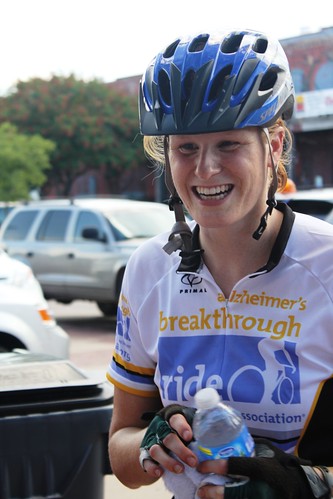 5:45 AM on August 18th marked the beginning of my long anticipated ride from Oklahoma City to Wichita, Kansas and also the midpoint of the Breakthrough Ride. I had the wonderful opportunity to attend the signing event in Oklahoma City the previous day, where I was further inspired for my ride by the volunteers and the many people willing to sign the petition and recognize the importance of Alzheimer’s disease at a national level. Here I also met my riding partner, Tom Kukars, and we were passed the baton brain that would ride on my handlebars for the next 2 days. After our briefing and a wonderful breakfast with the support crew, who were to be our heroes for the next two days, we headed out to the starting point. The ride along Oklahoma’s sunny back highways was beautiful; we wound around rivers and through the hills. Throughout the day we passed fields of red tilled earth, grassy rolling hills, and cattle, who often seemed very concerned by our presence and occasionally would run away as fast as they could to hide in the trees. This was my first trip to Oklahoma and I admit I was surprised by the number of hills, some quite steep, that Tom and I climbed on our way to the Kansas border. With the rolling hills and the heat, which topped out at 108 degrees, our support crew became our saving grace. As each rest stop drew near we could see the pony waiting and Evan always with a smile, encouragement, cold water, and towels. When we needed to cool down between scheduled stops, Melanie in our lead car would scope out some shade, and she and Glen, our caboose, made sure our water and Gatorade was full and as cold as possible. We were very spoiled to have such wonderful support throughout the ride, both in planning and execution, who also made it impossible not to have a great time. During the final leg of our journey into Tonkawa the hills receded and we were lucky to have a little tailwind at times. I could feel my body tiring, but knew I would not stop. The millions of people suffering from and caring for people with AD can never stop, so neither would I. We completed our day in Tonkawa and had a lovely dinner at a local home-style diner near our comfy hotel in Blackwell. It was here that Tom and I received our official nicknames from the pony support staff: pickles and puddin’. Previously in the day I was dubbed Ripley, and if the bugs I fought off riding that afternoon were aliens the name might have stuck, however it was pickles that I would answer to for the rest of the ride. That evening when I recalled the events from the day, I felt that I had accomplished something much more than this single day on my bike or a day in the laboratory. I am honored to be part of the Breakthrough Ride, an event that can actually change the way this nation addresses Alzheimer’s disease. I was unable to help my grandmother and grandfather as Alzheimer’s disease slowly took them from my family, but on this day I felt that together with all the riders, researchers, volunteers, and people signing our petition, I was helping to defeat this disease. I dedicate this day, the longest day of my ride, to my family, those we lost and those who worked tirelessly as caretakers for so many years.
-Jerrah Holth is a molecular and human genetics doctoral candidate at Baylor College of Medicine in Houston.Holth’s segment of the ride began on August 19 in Oklahoma City and ended on August 20 in Wichita, Kansas.
Alzheimer's Breakthrough Ride Journal: Segment 9
 Joachim Herz, M.D., is a professor at the Graduate School of Biomedical Sciences at Southwestern Medical School in Dallas. Dr. Herz’s research has identified several fundamental molecular mechanisms that are common to both Alzheimer’s disease and atherosclerosis. This summer, he is participating in the Alzheimer’s Breakthrough Ride to raise awareness and make Alzheimer’s disease a national priority. Dr. Herz’s segment of the ride began on August 16 in Dallas and ended on August 18 in Oklahoma City. You can follow Dr. Herz's Alzheimer's Breakthrough Ride exploits from Dallas to Oklahoma City by clicking here.Click here to sign the petition to make Alzheimer's disease a national priority.
Alzheimer's Breakthrough Ride Journal: Segment 9, Day 1
Dallas to Whitesboro, TX As my plane was about to land in Dallas on Sunday, the pilot announced that the temperature was 102. On Sunday evening the meteorologist on a local TV station described Monday as a cooler day, his forecast: temperature 101, heat index 110. Monday morning, at 5:45 I met Joachim Herz, the researcher-rider on this segment, and Melanie Katz, the “ride mother”, in the lobby of the Courtyard on I-35. After a quick breakfast and ride briefing at Denny’s, we headed for the petition signing event at Pegasus Plaza in downtown Dallas. Just before the event, I stepped into a car to do an interview with Rick Hadley from WBAP radio. Gerry Sampson, Vice-Chairman of our National Board, who attended the event with his Dallas Chapter volunteer and staff colleagues, tells me that the interview ran all day. Thanks to Rick and WBAP for helping us to advance our mission. The Breakthrough Ride, of course, is aimed at advancing our mission by moving our federal leaders to take action on Alzheimer’s the way they have on cancer, heart disease and HIV/AIDS. Those investments have worked and many, many lives have been saved. The research investments in Alzheimer’s are very low by comparison. We have no treatment that slows or stops the progress of the disease and no national plan to address the burgeoning crisis. Our job is to change all of that. As Joachim and I rode through the early morning on shaded bike paths, along the tree lined streets of some very nice Dallas neighborhoods and under the Live Oak canopy on the campus of SMU, we knew we faced the meteorologist’s forecast later in the day. In the metaphor that is this ride, we were experiencing the enjoyable years of life that too many of us too often take for granted. By the second scheduled rest stop the heat had increased, but we enjoyed a picnic-style lunch in the welcome shadow of a homeowner’s tall wooden privacy fence. After that stop, little shade graced our path to the end of the day’s ride. The collaboration that the Alzheimer’s Association and the research community have demonstrated in the Alzheimer’s Disease Neuroimaging Initiative and in so many other ways, served as a model for us as riders. We took turns leading into the headwind that faced us almost continuously, and we alternatively rode side by side on the lane-width shoulders of Texas rural highways to break the effects of the oppressive heat, the unrelenting headwind and the paved but sometimes bone-shaking roads. At rest stops we’d douse ourselves in water as our last act before departing and within minutes in the intense sun and steady wind, after covering only a mile or two, we were dry. As we rode on, I thought about the very real day-to-day challenges faced by individuals who have Alzheimer’s and their caregivers. My mother had it. Right now, as many as 5.3 million mothers, fathers, sisters, brothers, spouses and friends have it. Ten million baby boomers will have it. We have to stop it. The courage and endurance demonstrated by those who are facing this disease and by those who are speaking out about facing it inspire me daily. So, even at my most over-heated and fatigued moments, for the small contribution it might add, I had to finish the 80 plus miles of today’s route from Dallas to Whitesboro to advance our cause in a different way than I have the chance to do in my daily role. I am proud of the work of the Alzheimer’s Association. I am proud to be a Breakthrough Rider. -Harry Johns is the President and CEO of the Alzheimer's Association
Alzheimer's Breakthrough Ride Journal: Segment 8, Day 3
Aspermont, TX to Abilene, TX – 68 milesToday was the last leg of my Texas journey. After a decent sleep in the Bates Motel of Aspermont (really it was called the Hickman Motel and wasn’t all that bad), we were up at 5:00. After a morning gear check, filling up my bottles, and a quick breakfast in the Pony with Evan and Melanie, I was off at 6:30 AM to complete my ride. At that hour it is still pretty dark with some light on the eastern horizon. The good thing about getting out that early is that it was relatively comfortable without the sun beating down. I was racing the clock a bit here as my flight was out of Abilene at 1:30. So I pedaled away with Melanie behind me again to ward off all the semis doing 80 mph. The ride was pretty uneventful with, unfortunately, the same nondescript scenery along the empty roads. I did see my first armadillo, although the poor bugger was lying along the side the road expired after succumbing to a bad outcome with traffic. Just cruised along with quick stops to fill my drink bottles. The roads were largely the “Texas rattle roads” again, although our course took us off the main strip for the last 25 miles onto what was the worst road surface of the trek. I think the idea was to stay on less traveled roads but it was horrible. It was like riding bad cobblestones, and I thought the “rattle roads” were bad! Finally this stretch ended when I descended onto the outskirts of Abilene. It was so weird pedaling into Abilene in that you felt like you were coming back to civilization. There were now typical shopping and food stores we are accustomed to. It was only two days earlier that I left Amarillo but it seemed much longer. We were all joking that one day out in the back roads and tiny towns feels like a week. It is kind of like the “Inception” thing for those of you who saw the movie. Anyway got to the hotel, quickly broke down and packed up my bike and a fast shower. After a heartfelt goodbye to Evan and Melanie, my wonderful support crew, it was off the airport and on my way back to New York. I owe much thanks to Evan and Melanie for providing their very much appreciated support. Every stop, Evan was there quickly to bring me ice and water for me to mix my drinks and fill my bottles. Without Evan I would have surely melted away into the pavement. Melanie was my guardian angel, protecting my rear from generally courteous, but some obnoxious, 18 wheelers. Thanks for keeping me safe on those very hot and sometimes too narrow roadways and so that I did not become a statistic. I truly hope this ride does some good and Congress acts to pass this pending bill to increase Alzheimer’s disease research funding. Every stop we made, people came up to us to say they had a grandfather, a mother, an aunt, or someone that was affected with this disease. Every family is affected at some level. Having my own father succumb to this horrible disease last year without any effective treatments is a difficult thing to accept. During my ride, I would check in online and people would post comments wishing me and the other riders’ safety while biking and success with getting this bill passed and our research. I found one comment last night that really struck home for me. The person wrote in “Hundreds of thousands of people have survived cancer, heart disease, and strokes. Yet not one person has survived Alzheimer’s disease”. What else needs to be said. The continuous efforts by our labs and, importantly, the workers in our labs keep us moving towards this goal. Lastly, I want to applaud my fellow grunts, before me and after me, that have or will toil on the narrow, hot, humid, and dusty back roads. While out on the road melting away in the middle of nowhere, with not a person to be seen for miles and miles, I was thinking it would be so cool to pedal into a big city with a big signing event. But that is not what my leg from Amarillo to Abilene was about. Our role as grunts is to keep this show moving on its way to Washington. I hope that I, and the rest of you, have the opportunity to go down to Washington for that last leg of the ride to pedal in with the rest of the group to deliver these signatures to Congress. You have all earned it! Safety and perseverance to the continuing riders and our dedicated support crew. CU in DC! -Dr. William Van Nostrand
Alzheimer's Breakthrough Ride Journal: Segment 8, Day 2
Matador, TX to Aspermont, TX – 94 milesI had a good night’s sleep at the B&B in Matador, although another hour or two would have been nice. The owner of the B&B got up in the dark to prepare us our breakfast to start the day. After this meal with my support crew Evan, Melanie and I hit the road at 7:30 for the day’s ride. The first couple of hours were tolerable with the heat, but the humidity was definitely up from yesterday. After one hour I was dripping already! Then at about 9:30, with the sun higher, the mercury shot up. It was 102 today, and with the higher humidity it felt wonderful (extreme sarcasm). Even after our dinner that night at 6 PM, it was still 100 out. At least the winds were calmer this day. When out on the road, be grateful for any small gift from Mother Nature. The first 25-30 miles were to the small town of Paducah. This was the most interesting part of the ride as the terrain changed from largely flat to steady rolling hills. Despite the increase in climbing, the abatement of the wind allowed me to pedal several miles per hour faster. That was some steady wind yesterday. There were lots of cows again and interesting looking ravines and vegetation. As with yesterday, after I passed any cows they would look and just start running after me. Maybe they have never seen someone form New York before! It again was so fun to watch and nearly the only thing that broke up the grind. Once I hit Paducah it was a right turn (only turn of the day) then heading due south to Aspermont. Besides Paducah, the only other town (if you call it that) I passed through was Gutherie before coming into Aspermont. At this point it became extremely tedious again with not much to look at. Even the cows must have known better and disappeared. I had one 8 mile stretch of smooth road. After chattering all morning on the pavement it was equivalent to skating on freshly groomed ice. Of course this treat was short lived and I was back on what I affectionately called “Texas rattle road”. One particular section the stones were not quite pushed in that deep and it was really bumpy. This 60+ mile stretch of the ride was quite intense, the sun was scorching and humidity was up. These conditions really take it out of you. I went through 15 bottles of water and my electrolyte drinks and was taking one electrolyte pill every 20-30 minutes. The fluids just kept sweating out of me. Hours later I was still trying to replace the fluids I lost during the day. With the boredom of the ride and intense heat, I tried to find ways to keep my sanity and mind busy. I would ride the painted white line in the road as long as I could since this was the smoothest part I could find. I would look for a cloud on the horizon and imagined rain would be coming. Never happened, although we did see a big thunderstorm off in the distance. Then I would try to avoid all the very large grasshoppers sitting in the road. I know insects aren’t the smartest creatures but grasshoppers are sure stupid. First, why are they sitting on black asphalt in the middle of the day under scorching sun? Second, they see me coming, they get up their legs like they are ready to spring, and then just sit there. I had to swerve constantly to avoid them. It was like pedaling the gauntlet. Some weren’t so lucky….crunch….as my tires engaged them. Anyway it was very tough outside and I was glad to finish my 94 miles today and get in my air conditioned hotel room. Charming like the B&B of last night in Matador it was not, but it was cool and out of the sun. Remember, small gifts on the road are cherished. Highlights of this day were again my silly cow friends along the way in the morning, Evan waiting with ice, water, lunch and the air conditioning on in the Pony, and learning about the 6666 ranch at breakfast in Matador. Apparently the 6666 ranch is the, or one of the, largest ranches in Texas. The heiress of the ranch is one of the wealthiest people in Texas we were told. It is ENORMOUS. I cycled around just one corner of it and it goes on and on and on for miles. The interesting story about the ranch is that it was won in a poker game several generations ago. The winning hand, as you may guess was four of a kind…6666….hence the name. Pretty cool story. -Dr. William Van Nostrand
Alzheimer's Breakthrough Ride Journal: Segment 8, Day 1
Amarillo, TX to Matador, TX – 120 miles After a good nights sleep in Amarillo I was up at 5 AM to get ready and meet the support crew (Evan, Melanie, and Celeste) for breakfast and to go over the day ahead. The first thing that struck me was how dark it was at 6 AM here. It did not start getting light until well after 6:30. So much for trying to get out early to beat the heat! The support crew is great. Evan driving the Pony and Melanie driving the small SUV following me most of the time. It was very good having her following me with her flashing light and blinkers on as I was out in the right lane most of the time pedaling and this avoided me getting squashed by some big semi barreling by. We started off with a bang (literally). Two miles into the ride I blew a flat. Changed out the tube and then that one blew as well. Turns out I had a bad tire I put on before leaving home and it would not sit properly on the rim. After replacing the tube for the third time and a new tire I was finally on my way. I found this first day of the ride very challenging both physically and mentally. Although I have done rides similar to this length in my training and racing this just seemed tough today. The terrain was pretty flat but I had to face a very stiff headwind for almost the entire day. That constant fight with the wind, the soaring temperatures, and being alone in the middle of nowhere most of the day started to take its toll. I was very overheated and my legs were tightening up so miles 80-100 were brutal. Although I found the roads in Texas to be very clean with no trash or debris, the surface of them leaves more to be desired. It was pressed gravel leading to my bike chattering almost the entire ride. Even with a carbon frame, that constant rattling takes its toll on your body. I had to check the fillings in my teeth when I finished. At mile 100, we changed directions just a bit and wind went from head on to a bit of a crosswind. Although still not great, I found this a relished treat for the final twenty miles and I had my best stretch of pace at the end. In any case it was good to be finished at 120 miles with Evan waiting in the Pony. We came into the very small town of Matador, which is literally a half a block long. We all looked at each other like “where are we sleeping?” However, we stayed in a very nice B&B called the Matador Hotel. It was quite charming and comfortable. Dinner was another story. There was only one little place to eat in town serving only fried foods with no veggies to be found! Not exactly what I was looking for or needed in my body, but you got to do what you got to do. I had chicken fried chicken (isn’t that redundant?) for dinner. It didn’t matter that much, as I was ready for sleep. The highlights of the first day were the ranch animals. The horses and cows were so funny. They must have never seen anyone on a bike before. Whenever I passed them they all stopped doing what they were doing and ran up to fence where I was. One set of three horses was out in a pasture and they galloped up to see me and ran along the fence following me. All these animals had expressions that were unique, really (or maybe it was sunstroke). Melanie and I got such a laugh to see them react. They all did it every time I would pass them. I must have indeed been a rare sight, because a road crew guy saw me coming up the road. I had to stop a minute to wait for some construction to clear. He came up to me and said he thought he was seeing a mirage and then realized it was some guy on a bike. He couldn’t believe I was out there in the middle of nowhere in the heat. So I guess the horses and cows weren’t the only ones!
-Dr. William Van Nostrand
Alzheimer's Breakthrough Ride Journal: Segment 7, Day 1
Followers of the Alzheimer's Breakthrough Ride may have noticed that segment seven's journal has thus far recorded only days two through four. It is with great pleasure that we now provide the much-anticipated lost scroll of Captain Blowout, detailing Dr. Steven Barger's epic account of his exodus from Albuquerque.Call me Captain Blowout-- Kyle does. Seriously, I can't believe that two flat tires is any sort of record or anything. Even for the Albuquerque-to-Amarillo leg that I will be riding singlehandedly (but, for the most part, doublewheeledly). So, I would prefer to be known by the name my parents gave me: Steve Barger. I'm a researcher at the Reynold Institute on Aging at the University of Arkansas for Medical Sciences. Yes, Arkansas does indeed have a med school, believe it or not. And internal combustion engines. So riding a bicycle is a choice for me. Riding a bicycle on this trip has turned out to be a very GOOD choice already! Among other things, the weather has been delightful! I remember when I first communicated with Bruce Lamb about participating. Because the planned route did not pass through my home state, I told him I'd be willing to ride any leg of the journey. He said that there was a paucity of riders signing up for the desert states, "understandably." I told him I would jump at the chance to get out of Arkansas's heat and humidity! One at a time is fair fight-- divide and conquer, right? But together, the ol' H-n-H is a brutal combination. It's funny to me that so many people have a fear of the weather in the desert southwest. When I told the folks back home what I was doing, the response was almost invariably, "Goodness-- New Mexico? In AUGUST? Won't that be HOT?!" They continued to say this during the week preceding my departure while Arkansas was suffering repeated days that exceeded 105 degrees F! With 80-90% humidity! For those of you who haven't experienced this particular form of anguish, it may surprise you to learn that it's easier to dehydrate in such a clime. In such humidity, perspiration doesn't evaporate. It just soaks your clothes and pours down on your bike components to corrode them like acid rain. And because it's not cooling you, your body responds in the only way it can: sweating MORE! It's not uncommon for me to finish a ride 8 lbs. lighter than I started. This after drinking almost 8 lbs. of liquids during the trip! The biggest nuisance about riding through The Land of Enchantment that I've encountered is that I have to stop for bathroom breaks. It's hard to adjust to the fact that I have so much spare liquid that it can be simply cast off as waste. So, 300 some-odd miles from Albuquerque to Amarillo...? Quite the luxury. Bruce was at the hotel in Albuquerque this morning, along with the other riders from the preceding leg, to see me off. What with my briefing on road rules and the route by Melanie and Kyle, the company made for quite a gregarious breakfast to a guy who's accustomed to morning conversation that rarely gets beyond "snap, crackle, and pop." There was even a bleary-eyed appearance by Evan, who had the day off but nevertheless got up early out of homage to the passing of the torch. (Or the BRAIN, rather. One rider on each leg is carring a little foam brain talisman zip-tied to his/her handlebar stem. Just wouldn't be a relay without that, ya know.) It was fun to hear my predecessors tell stories from the road embellished with metaphors from the lab-- this is indeed quite a unique event. Melanie wondered aloud whether cyclists are over-represented among researchers. Conventional wisdom says that scientists are geeks, not jocks, right? Tell that to Bill Van Nostrand, Ironman triathlete and (I'm told) a top finisher in a recent open-water ocean swim off of Long Island. Bill's so hardcore that he requested that his 4-day Breakthrough leg from Amarillo to Abilene be shortened to 3 days so that he could "get a good workout"! Maybe he'll get lucky and have a 15-20 mph headwind too. I had such joy for much of today. That, combined with the 1000-ft climb to traverse the Sandia range and the inevitable delays of urban riding, made the first 15 miles out of Albuquerque a bit sluggish. But I managed to catch up with another cyclist who was out for a morning ride. When I told him about the purpose of my trip, he replied that his mother is currently suffering from Alzheimer's. We rode along together for four or five miles, talking about the progression of the disease, risk factors, and the state of current research. It was gratifying to have, so early in my leg, a personal demonstration of how our mission could affect the lives of others. I can't close this entry without expressing my thanks to everyone involved: to Bruce for having the idea, to the Alzheimer's Association for committing to it, to the other riders for their dedication both in their labs and on their bikes, AND... to our wonderful support crew! Eric was very helpful and informative on the eve of my embarkment. And along with the nice weather, Melanie and Kyle have made the miles on the road some of the most enjoyable I've had in a long time. They are always quick with an uplifting joke for the weary, a tire pump for the flat-prone, and water-- even for a guy who thinks he needs none. (ESPECIALLY, for that guy!) -Steven Barger, Ph.D., is a Professor in the Departments of Geriatrics, Neurobiology & Developmental Sciences, and Internal Medicine at the University of Arkansas for Medical Sciences (UAMS) in Little Rock. He is also a Research Health Scientist in the Geriatric Research Education and Clinical Center at the Central Arkansas Veterans Healthcare System.
Alzheimer's Breakthrough Ride Journal: Segment 7, Day 4
Vega to Amarillo New day, new nickname: “Prairie Dog.” Pretty obvious—we are on the Great Plains, doggin’ it through stiff winds and tall grass. (The shoulders are quite nonexistent on many of these rural highways.) No need for sunscreen or food today. The trip would be just 48 miles that began at the first little crack of dawn. It was difficult to drag Evan away from the remarkable oil paintings at the Day’s Inn in Vega, but we all wanted breakfast, and what they were serving at the point of origin hardly qualified. So off we set for Amarillo and… civilization! (cough) Celeste had mapped out a bit of loop that had us heading south, then east, then north, then east again along the access road for I-40. Though there was good light, I played it safe with a headlamp and activated my taillight. At the nine-mile mark, these were no longer necessary, and I summoned Evan up beside me to take the headlamp and its weighty battery pack in a handoff on-the-fly (thus satisfying one of his stated goals for the trip). Knowing that I would be stopping only under extraordinary circumstances, Kyle remained stationed at The Pony’s steering wheel as he waited at the appointed rest stops. At each, my “thumbs up” was answered with a jaunty salute from the Irish Cap’n, and we rolled on unimpeded by tumbleweeds, armadillos, or real prairie dogs. I suppose they either stayed out too late on Saturday night or were busy readying themselves for church on this pretty Sunday morning. I did catch a glimpse of the iconic installation of half-buried Cadillacs a few miles from the Amarillo city limits, but it seemed rather unremarkable at 24 mph. Arriving at the Amarillo Marriott Courtyard, I finally had an opportunity to meet the mythical Celeste. She had kept herself a day ahead of us, scouting out the route and making last-minute revisions for the namby-pampy rider who was afraid to ride on I-40 per se. Evan, Kyle and I had breakfast at the hotel that included some hearty omelets. Then I retired to shower and wash my Breakthrough Ride jersey in anticipation of a small petition-signing event organized by Tracy Sommers of the Amarillo chapter of the Alzheimer’s Association, who singlehandedly serves as president, v.p., secretary/treasurer...but she did a bang-up job of setting up awnings, brochures, refreshments, local TV coverage, and-- of course-- the petition. It was difficult to attract interest from passersby at 2:00 in the afternoon, but we did get a few curious parties, all of whom signed and wished us luck in our endeavor. It’s been an absolutely wonderful experience participating in this momentous event! I bequeath the brain “baton” to Bill Van Nostrand in absentia-- he will not arrive until after I’ve left tomorrow. But I’m sure he will carry on valiantly. As will Celeste, Melanie, and Evan, doubtlessly. (Kyle is leaving the tour, at least for the time being.) They have been the funnest, most capable crew anyone could ask for. Thanks again to everyone involved, and… SEE YA IN D.C.!!! -Steven Barger, Ph.D., is a Professor in the Departments of Geriatrics, Neurobiology & Developmental Sciences, and Internal Medicine at the University of Arkansas for Medical Sciences (UAMS) in Little Rock. He is also a Research Health Scientist in the Geriatric Research Education and Clinical Center at the Central Arkansas Veterans Healthcare System.
|
- Name: Action Alz
- Location: Chicago, Illinois, United States
The Alzheimer’s Association is the leading voluntary health organization in Alzheimer care, support and research.
Our mission is to eliminate Alzheimer's disease through the advancement of research; to provide and enhance care and support for all affected; and to reduce the risk of dementia through the promotion of brain health.
View my complete profile

Subscribe to
Posts [Atom]
|


 |
|